12 Symptoms You Should Never Ignore in Children


Cystic Echinococcosis (Hydatid Disease)
Cystic echinococcosis (Hydatid Disease) represents an emerging illness found in humans and livestock that arises as a result of eating infective eggs of the cestode parasite Echinococcus granulosus – a small tapeworm of carnivorous animals.
Also known as hydatid disease, this condition remains a significant cause of morbidity and mortality worldwide.
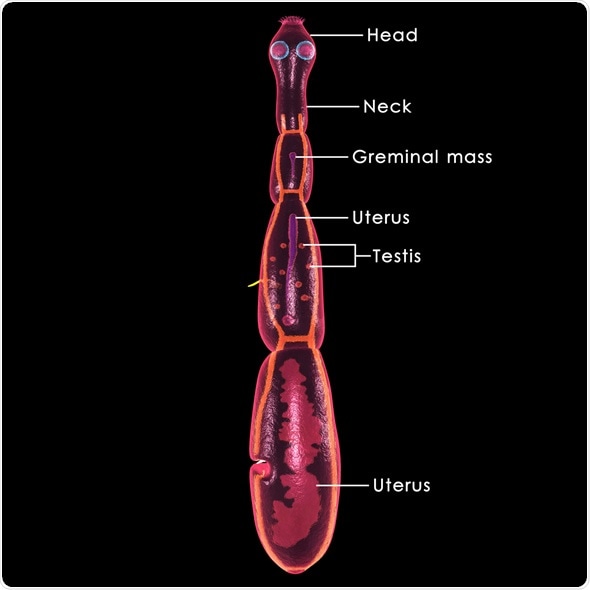
Echinococcus granulosus - Image Copyright: sciencepics / Shutterstock
The ingestion of Echinococcus eggs results in the release of an early-stage larva (also known as the oncosphere) into the intestinal tract, with subsequent migration via blood or lymph to primary target organs such as liver or lungs.
At those locations, the oncosphere can mature into a vesicle which can grow by concentric enlargement, resulting in a fully mature hydatid cyst.
Cystic echinococcosis is not only responsible for severe disease and possible fatal outcomes, but also leads to high economic burden due to treatment costs, livestock losses and lost wages.
In the recent years noteworthy technological improvements have been made in characterizing, diagnosing, and treating infections with Echinococcus granulosus.
Clinical PresentationHuman cystic echinococcosis is characterized by a variable asymptomatic period during hydatid cyst growth, which depends on the patient age, site of cyst development, as well as the existence of a single or multiple cysts.
Approximately 70-80% of cysts are found in the liver, 10-20% in the lungs and only 5% in other sites in the human body (such as bones, spleen, central nervous system, or eyes).
Hydatid cysts can remain asymptomatic for life, especially if they stay small. If symptoms develop, they are most often associated with pressure effects of the cyst on surrounding tissues or organs. Non-specific signs that can appear include weight loss, anorexia, and weakness.
Nevertheless, traumatic rupture of the hydatid cyst is a serious manifestation that may lead to fatal anaphylaxis (i.E. A severe and extreme allergic reaction).
Other potential cyst complications include fistulas leading to bronchial or biliary obstruction, embolism of cyst content, and bacterial superinfections.
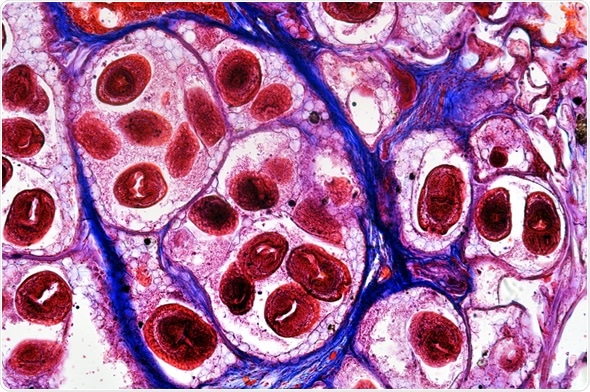
Echinococcus granulosus - Hydatid worm in liver. Image Copyright: D. Kucharski K. Kucharska / Shutterstock
Diagnostic ApproachesDue to its availability and convenience, the introduction of ultrasound in the clinical practice in the late 1970s has substantially improved the detection of cysts in the liver and abdomen.
World Health Organization developed a standardized classification system (pervasive in modern medicine) which divides hydatid cysts into six stages: CE1 and CE2 (active stage), CE3a and CE3b (transitional stage), and CE4 and CE5 (inactive stage).
Serology is also helpful, but its usefulness is limited by a lack of sensitivity and specificity.
Still, the combination of ultrasound technique and confirmatory serology represents a standard approach for epidemiological and clinical surveys. In unclear cases, diagnostic puncture of the cyst is performed by an experienced examiner.
Treatment and PreventionIn general, four different modalities are available in the treatment of hydatid disease: antihelminthic treatment, percutaneous drainage techniques, surgery, and "watch and wait" approach.
However, the management of patients depends not only on the individual case, but also on local expertise and available resources.
Surgery is indicated when there are large hepatic cysts (with multiple daughter cysts) or superficial hepatic cysts with the potential of spontaneous rupture.
Although antihelminthic treatment with benzoimidazole carbamates (i.E. Mebendazole or albendazole) was once reserved for inoperable cases of human cystic echinococcosis, today they are more widely employed.
In this century, the percutaneous treatment known under the acronym PAIR (puncture, aspiration, injection, reaspiration) has secured an indispensable role in the treatment of hydatid disease.
In cases of small, non-complicated hepatic cysts, it is possible to consider the aforementioned "wait and see" approach as cysts can remain the same or stabilize even further.
The most effective preventive intervention against cystic echinococcosis is a combination of dog antihelminthic treatment and sheep vaccination.
Although successful control programs are important at the local level, the global distribution and public health significance of hydatid disease have not substantially changed.
Further ReadingWhat Is Hydatid Disease?
Hydatid disease, also known as echinococcosis, or cystic hydatid disease, is caused by an infection with the larvae of the tapeworm Echinococcus granulosus. This parasite causes slow-growing cystic formation and associated symptoms that depend on cyst location.
Hydatid disease occurs in Central and South America, Africa, and Asia, but rarely in North America.
What is the Echinococcus granulosus tapeworm?The adult tapeworm typically measures between 3 and 6 mm in length and 0.5 mm wide. The head features four prominent suckers as well as a double row of hooklets on the rostellum. They reside in the intestine parasitically and are most commonly found in the jejunum, the middle area of the small intestine. After attaching itself to the mucous membrane, the worm takes approximately eight weeks to fully mature and is thought to have a lifespan five months. Male and female sex organs develop in the proglottids distal to the scolex and can contain several thousand eggs. Definitive hosts are carnivores such as dogs, with intermediate hosts being pigs, cows, and sheep. Dogs would become infected after eating intestines from intermediate hosts, whereas humans are accidental hosts.
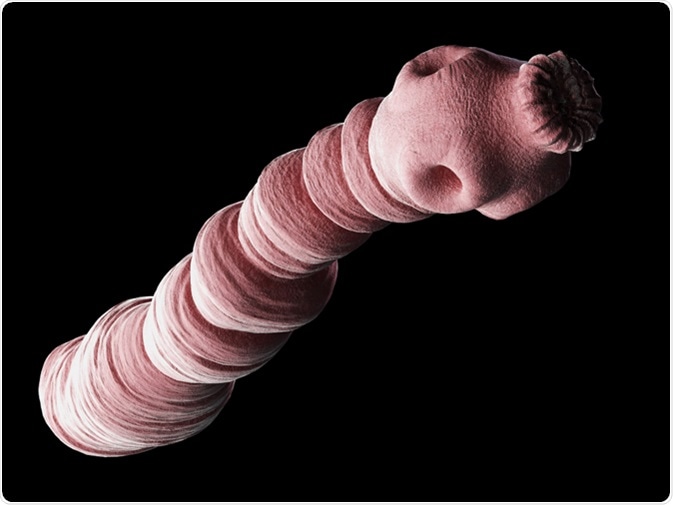
3d illustration of an Echinococcus granulosus - Image Credit: Sebastian Kaulitzki / Shutterstock
Transmission of the DiseaseDuring maturation of the distal proglottid, separation from the main body of the tapeworm occurs and subsequently disintegrates releasing ova which can then be passed into faeces. Any ova released may contaminate grass, vegetables or the fur of animals which excreted the ova. If animals then feed on the grass containing the ova, they then can become infected and become an intermediate host for the parasite. Definitive hosts are those that consume infected intestines from the intermediate hosts.
The disease can then be passed onto humans through the ingestion of contaminated water or vegetables, or by close contact with dogs who are infected (dog licking a person's face or a person eating food contaminated with dog faeces). Following ingestion, the outer membrane of the ova is digested by either the intestinal or gastric juices. The ovum is then free to penetrate the mucus of the villi located in the intestine, followed by the capillaries and by traveling in the bloodstream, enter the liver. The sinusoids of the liver act as a filter, resulting in the retention of the ovum in this area. However, some may still escape and go onto to enter the lungs. In some cases, further transportation is seen whereby the ovum passes through the lungs and into the arterial blood resulting in the possibility of lodging in a number of organs in the body.
In the majority of human cases, approximately 15% of the ova reside in the lung, 70% in the liver, and the remaining ova are found in several other locations including but not exclusive to the brain, bone, kidney and spleen. Fewer incidents have been reported where the ova has lodged itself into the heart.
Cyst FormationAny ovum retained in the organs can multiply to develop into a spherical mass which is surrounded by a homogenous layer of endocyst. A serous vesicle then forms at the centre of the mass. The whole vesicle enlarges resulting in the cells becoming arranged around the germinal layer. Neighbouring tissues of the host react to the foreign body by producing a membrane around the cystic structure. This membrane is often referred to as the ectocyst or adventitia and can vary depending on which organ the cyst is inhabiting.
What are the symptoms of hydatid disease?Cysts that develop in cases of hydatid disease are often slow-growing which means that the infection may not produce noticeable symptoms until a few years following the initial ingestion.
In cases where symptoms do develop, they are dependent on where the cyst is located. For example, if lodged in the liver, nausea, vomiting and abdominal pain may be experienced. If found in the lung, individuals may develop chest pain, shortness of breath and a chronic cough. Other, non-specific signs may develop including weakness, weight loss and anorexia.
TreatmentsResearch has found that the only effective method of treating cases of hydatid disease is through surgical removal of the cysts followed by a course of chemotherapy.
PreventionCurrently, there aren't any preventative methods such as vaccines to protect humans against developing the disease. However, certain measures such as not feeding dogs uncooked food, washing hands thoroughly after being in contact with dogs, washing fruit and vegetables before cooking and eating them can be taken to reduce the likelihood of contracting the disease.
Further ReadingWhat Is A Liver Cyst?
Liver cysts are sacs in the liver that may contain fluid or a solid mass of cells. Most cysts on the liver are present from birth and do not cause symptoms.
Sometimes, however, if the cysts become large, a person may experience pain or other symptoms that require treatment.
In this article, we explore the causes, symptoms, and complications of liver cysts and when to see a doctor. We also cover diagnosis and treatment and what cystic tumors are when these occasionally occur.
Cysts that grow in the liver are often congenital. This term means that the cysts formed before birth, while a person was developing in the womb.
Liver cysts can also occur at any point during a person's life for reasons scientists have yet to discover. According to a 2015 study, women are more likely to develop liver cysts than men.
Infection with an Echinococcus tapeworm can also lead to liver cysts. These parasites are often present in farm animals or animals that live on farms, which can include dogs, wolves, and coyotes. A person can become infected with Echinococcus through exposure to the feces of these animals.
Infection with Echinococcus is known as hydatid disease, cystic hydatid disease, or echinococcosis. This condition can also cause cysts in the lungs, kidneys, brain, and other organs around the body.
Polycystic liver disease (PLD) is another condition that can cause liver cysts. PLD is a rare genetic condition, which means that it runs in families.
People with PLD develop multiple cysts throughout their lives, but the condition often causes no symptoms. Many individuals with PLD also have polycystic kidney disease.
Other causes of liver cysts include liver cancer and injury to the liver.
Share on PinterestWhen a cystic tumor becomes malignant, doctors will usually recommend surgery.Rarely, liver cysts can multiply or grow so large that they begin to affect the function of nearby organs. For example, a very large cyst may obstruct the vena cava, a major vein that carries blood back to the heart. In this instance, a doctor may recommend surgery to remove the cyst or cysts.
Liver cysts are usually benign, which means they are not cancerous. However, around 5 percent of liver cysts are cystic tumors.
Very rarely, these cystic tumors can become malignant and can spread beyond the liver. Because of this, doctors will usually recommend surgery to remove a cystic tumor completely.
Because liver cysts often cause no symptoms, people usually only discover they have them while undergoing an imaging test for something else.
If a person does have symptoms that may indicate a liver cyst, a doctor may order an imaging test, such as an MRI, ultrasound, or CT scan.
They might also recommend a blood test to determine if a person has an Echinococcus infection.
Share on PinterestLaparoscopic surgery is the most common method of surgery when removing liver cysts.Most people with liver cysts do not require treatment unless they are experiencing symptoms.
If liver cysts are causing problems, a doctor may drain the cyst by inserting a fine needle through the abdomen. However, this is usually only a temporary treatment as the fluid can return over time.
The most effective treatment for liver cysts is surgical removal. Surgeons can usually remove the cyst using a laparoscopic approach, which involves making only 2 or 3 small incisions into the abdomen. After removal, cysts are unlikely to return.
A doctor may prescribe antibiotics for people with an Echinococcus infection.
In rare instances, a person with PLD or polycystic kidney disease may require a liver or kidney transplant if their condition is causing life-threatening symptoms.
Scientists are also researching medications, such as somatostatin analogs, to treat and manage liver cysts without surgery.
Around 5 percent of liver cysts are cystic tumors, which are abnormal growths that have the potential to become cancerous over time. However, most cystic tumors are benign, and only around 5 percent of them become malignant.
Although cystic tumors usually do not cause symptoms, it can be difficult to distinguish between a potentially cancerous tumor and one that is harmless, or benign.
A doctor may order a biopsy to determine if a cystic tumor might be potentially malignant. However, they will often recommend that a person has surgery to completely remove a cystic tumor and ensure that they do not become cancerous.


Comments
Post a Comment