Your Guide to the Symptoms of the New Coronavirus and COVID-19


What To Know About Hantavirus, The Disease That Killed Betsy Arakawa - AOL
The virus that killed Betsy Arakawa, the wife of Gene Hackman, is a relatively rare but devastating threat without a vaccine, treatment or cure.
Hantaviruses, a family of pathogens, are spread by rodents, mostly mice, and excreted in the animals' saliva, droppings and urine.
In New Mexico, where Arakawa and Hackman lived, the most common carrier of hantavirus is the deer mouse, a small creature with a white underbelly, large eyes and oversize ears.
"It's a horrible disease," said Dr. Jeff Duchin, a retired public health officer in Seattle who helped characterize the first known outbreak of the disease in the U.S. In 1993. "It's not uniformly fatal and it's not always severe, but the fatality rate is still thought to be up to 40%, which is really high."
Arakawa, 65, died from hantavirus pulmonary syndrome, and Hackman, 95, died a week later of hypertensive and atherosclerotic cardiovascular disease, officials said Friday. Alzheimer's disease was a significant contributory factor in Hackman's death.
What are the symptoms?In the U.S., when a person is infected, the virus often causes fatigue, fever and muscle aches, according to the Centers for Disease Control and Prevention. Some people dealing with the infection, called hantavirus pulmonary syndrome (HPS), can have headaches, dizziness, chills and stomach problems.
"Initially, there's nothing specific that would tell you you have hantavirus. You could think you have Covid or influenza, or just a really bad community acquired infection," Duchin said.
Dr. Scott Roberts, an assistant professor at Yale School of Medicine, said symptoms can take up to eight weeks to present after an exposure. "It's very possible this is missed," he said.
In the most severe cases, hantaviruses can progress to the lungs and cause a dangerous respiratory disease. Symptoms include coughing, shortness of breath and fluid in the lungs.
"The fatal, rapidly progressive pulmonary illness can come on very quickly, in hours. That, itself, can become fatal on a very short timeline," Duchin said.
In its late stages, he added, the illness causes a "drop in blood pressure — leaky blood vessels — and that causes fluid to seep into the lungs and tissues and makes it very difficult to get oxygen and lowers the blood pressure, which is usually the cause of death and severe illness."
A transmission electron micrograph of the Sin Nombre hantavirus.
How common is hantavirus?The disease was first characterized in the United States in 1993 after an outbreak in the Four Corners area of the Southwest by a team of CDC staffers including Duchin and local New Mexico clinicians. Fourteen people ultimately died in the outbreak.
"Prior to 1993, this virus was not known and there was no other recognized hemorrhagic fever virus" in the U.S., said Duchin, who was part of the CDC's Epidemic Intelligence Service in 1993. "Young, healthy people were dying from this rapidly progressive pulmonary disease with no other explanation, which really set off alarm bells."
There have been 129 cases of hantavirus confirmed in New Mexico since 1993, according to the CDC. More than 860 cases of hantavirus were reported nationwide from 1993 to 2022.
"There's not much we can do — no vaccine, no treatment, it's supportive care," Roberts said. "The best way to treat this is prevention."
How do people get the disease?The disease is most frequently reported in the western United States, and particularly the Southwest, where deer mice are common.
"That's where it circulates in the animal population. That's where animals get infected and humans follow," Roberts said.
People tend to get hantavirus when they disturb droppings or urine from mice in the dusty corners of barns, cabins or outbuildings near forested land, including during cleaning.
The New Mexico Department of Health assessed the risk from hantavirus inside Hackman and Arakawa's home as low but found evidence of rodents elsewhere, Erin Phipps, the state public health veterinarian, said at a news conference Friday.
"We did identify signs of rodent entry in other structures on the property," Phipps said.
It's unclear how Arakawa contracted the disease.
If cleaning up living spaces after a rodent infestation, Phipps said it is important to wear gloves, use an N95 respirator, open windows and rely on disinfectants.
Other steps should also be taken, Phipps said, including "avoiding contact with or breathing in aerosolized rodent urine or feces, especially in a poorly ventilated area."
"Never sweep up or vacuum mouse droppings, since this can spread particles up into the air," she said.
The hantavirus family is also a concern in Europe and Asia, where a different version of the virus is spread by other rodent species, and can cause hemorrhagic fever with renal syndrome (HFRS).
Hantavirus Killed Betsy Arakawa; What Is It And How Does It Spread?
Actor Gene Hackman with wife Betsy Arakawa in June 1993. Credit: AP
Betsy Arakawa, a Classical pianist and the wife of recently deceased actor Gene Hackman, died of respiratory failure linked to a rare disease known as hantavirus, medical authorities said Friday.
The disease is found throughout the world in certain species of rodents, according to Dr. Bruce Farber, the chief of public health and epidemiology at Northwell Health. In America, he added, it is most commonly "clustered" in the Southwest states.
How is hantavirus contracted?While people can contract the virus through a bite or scratch from a rodent, it is more commonly contracted through inhaling urine or feces from certain species of mice, voles and other rodents, Farber said. When people "accidentally stir up those feces either cleaning or camping," he added, the virus enters the air and can be inhaled. This is more of a concern when cleaning in confined or unventilated spaces, such as garages.
The disease is not known to spread human-to-human, according to Farber.
How common is hantavirus?The Centers for Disease Control and Prevention began tracking the virus in 1993 after an outbreak was discovered in the Four Corners region, according to the agency's website. A total of 864 cases of hantavirus were discovered throughout the nation from 1993 through 2022. The most common culprit carrying the disease in the United States is the deer mouse.
How dangerous is hantavirus?Just over a third of all those who contract hantavirus in America die, according to the CDC.
In the United States, where it is generally clustered in the Southwest region, the disease can cause hantavirus pulmonary syndrome, a potentially fatal lung infection, according to Farber. In Europe and Asia, the virus more commonly results in renal failure.
"When you do get it, it's often rapidly fatal," as there is no direct treatment to combat the virus, only treatments to mitigate symptoms, or "supportive care," Farber said.
What are the signs and symptoms of hantavirus?Early on, a hantavirus infection may present itself "in a very nonspecific manner, like dozens of other diseases, everything from flu to pneumonia," according to Farber. Their initial symptoms would include muscle aches, fever and feeling "crummy."
These symptoms generally start to present themselves between one and eight weeks after exposure, according to the CDC, with an initial symptom of shortness of breath.
The late symptoms of the hantavirus pulmonary syndrome lung infection — including tightness of the chest as fluid fills the lungs — may begin four to 10 days after initial illness, according to the CDC. Of the people who develop respiratory symptoms, 38% die.
Have there been hantavirus cases on Long Island?From 1993 through 2022, six cases of hantavirus were recorded in New York, according to the CDC. Three people infected died, the infections were not fatal in two cases, and the outcome of the sixth case is unknown. New York accounts for less than 1% of all cases ever recorded in the nation.
While hantavirus is uncommon in the region, a pair of deaths were linked to local infections.
Shortly after visiting his family home on Shelter Island for Christmas 1993, Rhode Island film student David Rosenberg died, and was determined to have contracted the infection, according to prior Newsday coverage of his death and subsequent investigations.
Nearly a year after his death, researchers announced that mice trapped on Shelter Island tested positive for hantavirus and suspected similarly infected rodents entered his family home and their droppings became airborne when the home was heated ahead of his visit.
In 1995, Verod Anthony Hopson, a 25-year-old Bridgehampton landscaper also died of hantavirus, Newsday reported at the time. Suffolk County health officials linked Hopson's death to rodent droppings found in his home.
Nicholas Grasso covers breaking news for Newsday. A Long Island native, he previously worked at several community newspapers and lifestyle magazines based on the East End.
What Is Hantavirus? The Virus That Caused The Death Of Betsy Arakawa, Gene Hackman's Wife - NBC News
The virus that killed Betsy Arakawa, the wife of Gene Hackman, is a relatively rare but devastating threat without a vaccine, treatment or cure.
Hantaviruses, a family of pathogens, are spread by rodents, mostly mice, and excreted in the animals' saliva, droppings and urine.
In New Mexico, where Arakawa and Hackman lived, the most common carrier of hantavirus is the deer mouse, a small creature with a white underbelly, large eyes and oversize ears.
"It's a horrible disease," said Dr. Jeff Duchin, a retired public health officer in Seattle who helped characterize the first known outbreak of the disease in the U.S. In 1993. "It's not uniformly fatal and it's not always severe, but the fatality rate is still thought to be up to 40%, which is really high."
Arakawa, 65, died from hantavirus pulmonary syndrome, and Hackman, 95, died a week later of hypertensive and atherosclerotic cardiovascular disease, officials said Friday. Alzheimer's disease was a significant contributory factor in Hackman's death.
What are the symptoms?In the U.S., when a person is infected, the virus often causes fatigue, fever and muscle aches, according to the Centers for Disease Control and Prevention. Some people dealing with the infection, called hantavirus pulmonary syndrome (HPS), can have headaches, dizziness, chills and stomach problems.
"Initially, there's nothing specific that would tell you you have hantavirus. You could think you have Covid or influenza, or just a really bad community acquired infection," Duchin said.
Dr. Scott Roberts, an assistant professor at Yale School of Medicine, said symptoms can take up to eight weeks to present after an exposure. "It's very possible this is missed," he said.
In the most severe cases, hantaviruses can progress to the lungs and cause a dangerous respiratory disease. Symptoms include coughing, shortness of breath and fluid in the lungs.
"The fatal, rapidly progressive pulmonary illness can come on very quickly, in hours. That, itself, can become fatal on a very short timeline," Duchin said.
In its late stages, he added, the illness causes a "drop in blood pressure — leaky blood vessels — and that causes fluid to seep into the lungs and tissues and makes it very difficult to get oxygen and lowers the blood pressure, which is usually the cause of death and severe illness."
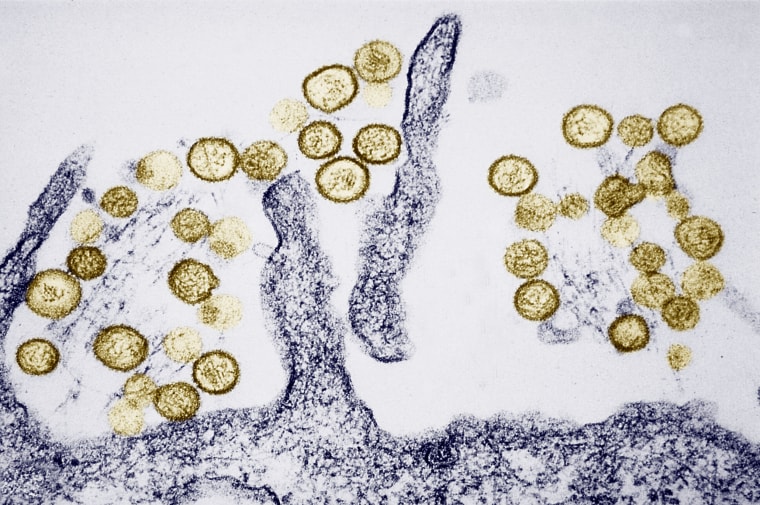 A transmission electron micrograph of the Sin Nombre hantavirus.BSIP / Universal Images Group via Getty Images
The disease was first characterized in the United States in 1993 after an outbreak in the Four Corners area of the Southwest by a team of CDC staffers including Duchin and local New Mexico clinicians. Fourteen people ultimately died in the outbreak.
"Prior to 1993, this virus was not known and there was no other recognized hemorrhagic fever virus" in the U.S., said Duchin, who was part of the CDC's Epidemic Intelligence Service in 1993. "Young, healthy people were dying from this rapidly progressive pulmonary disease with no other explanation, which really set off alarm bells."
There have been 129 cases of hantavirus confirmed in New Mexico since 1993, according to the CDC. More than 860 cases of hantavirus were reported nationwide from 1993 to 2022.
"There's not much we can do — no vaccine, no treatment, it's supportive care," Roberts said. "The best way to treat this is prevention."
How do people get the disease?The disease is most frequently reported in the western United States, and particularly the Southwest, where deer mice are common.
"That's where it circulates in the animal population. That's where animals get infected and humans follow," Roberts said.
People tend to get hantavirus when they disturb droppings or urine from mice in the dusty corners of barns, cabins or outbuildings near forested land, including during cleaning.
The New Mexico Department of Health assessed the risk from hantavirus inside Hackman and Arakawa's home as low but found evidence of rodents elsewhere, Erin Phipps, the state public health veterinarian, said at a news conference Friday.
"We did identify signs of rodent entry in other structures on the property," Phipps said.
It's unclear how Arakawa contracted the disease.
If cleaning up living spaces after a rodent infestation, Phipps said it is important to wear gloves, use an N95 respirator, open windows and rely on disinfectants.
Other steps should also be taken, Phipps said, including "avoiding contact with or breathing in aerosolized rodent urine or feces, especially in a poorly ventilated area."
"Never sweep up or vacuum mouse droppings, since this can spread particles up into the air," she said.
The hantavirus family is also a concern in Europe and Asia, where a different version of the virus is spread by other rodent species, and can cause hemorrhagic fever with renal syndrome (HFRS).


Comments
Post a Comment